
Guest blog: Using Qi to tackle a Qi challenge
Posted: 8th December 2025
Written by: Beccy Vallance, The Rotherham NHS Foundation Trust
At the Innovation Hub, we champion best practice and we collaborate to accelerate improvement. In this guest blog, Beccy Vallance, Head of Quality Improvement at The Rotherham NHS Foundation Trust, describes one example of how five trusts worked together to develop a solution to a shared challenge.
When a challenge presented itself to our organisation’s approach to quality improvement it caused us to take a fresh look at what we could do differently – and collaboratively.
We had been using QSIR (Quality, Service Improvement and Redesign) methodology but it became a paid service having previously been free – and we could not afford to continue using it.
Quality improvement is a systematic change approach and ensures we continuously improve our services, outcomes and pathways, leading to better patient care, safety, efficiency and workforce experience and wellbeing.
As Qi is crucial to our development of people and services, we decided to explore other options. This led to discussions with the South Yorkshire Qi Network where it was decided we could collaborate and build something together.
Five organisations: The Rotherham NHS FT, where I work; Barnsley Hospital NHS FT, Sheffield Health Partnership University NHS FT, Rotherham Doncaster and South Humber NHS FT, with South Yorkshire ICB worked together to develop a practitioner course in improvement that would be open to staff of all levels. We focused on a roadmap already used in another organisation and refined it to become the roadmap for the Improvement Learning South Yorkshire programme (ILSY), as seen below.
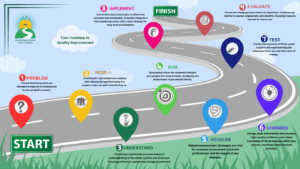
A three-day course was developed around the roadmap with practical exercises for each of the steps, culminating in a ‘snowflake factory’ simulation, bringing together the tools used in the training for delegates to put into practice to improve processes.
The course was as follows:
- Day 1 starts with focusing on the nature of the problem, gets attendees to brainstorm and map the people they need to involve, ways to engage with teams on improvement and what baseline data they need to gather. It ends with them creating a SMART aim for the idea they have brought to the course.
- Day 2 looks at measurement using data in a line over time and how to test their change ideas.
- Day 3 covers more on implementing changes and evaluation, use of SPC charts, quantitative data, driver diagrams, process mapping and using a fishbone framework as well as coaching techniques.
Over the last year this has been tweaked and in true Qi style will continue to evolve as it is used. There are currently five organisations using the methodology to deliver Qi training.
Each organisation runs two cohorts per year, with the option for staff from each organisation to attend a course at any of the other locations, which may be nearer to home as the value of learning from outside your own organisation is as valuable as the course content – further highlighting the benefits of collaboration.
At The Rotherham Hospital alone we have trained 207 staff since 2023.
Projects brought to the course in the last year have included:
- Increasing the number of people who receive an assessment and intervention at the first point of contact with the Community Occupational Therapy Service for all people from 40 per cent to 60 per cent within six months.
- Reducing waiting lists and DNAs for cardiac CT scans by 20 per cent by February 2026
- Improving compliance in following the PMO project management process and PMO Project Checklist from 10 per cent to 75 per cent by September 2025, for all health improvement projects started since April 2024 which are managed by PMO project managers and project support officers
- Reducing the time from check in to administration of Zometa infusions on a ward for myeloma patients from 53 minutes to 30 minutes or less, by May 2024
All these projects are underway with the last one going through the re-measure cycle to determine if their change is still working or requires further refinement. Our aim is to continue to support these Qi projects while planning for our new cohort!
If you want to find out how to embed Qi in your organisation, please email me at: Beccy.Vallance@nhs.net